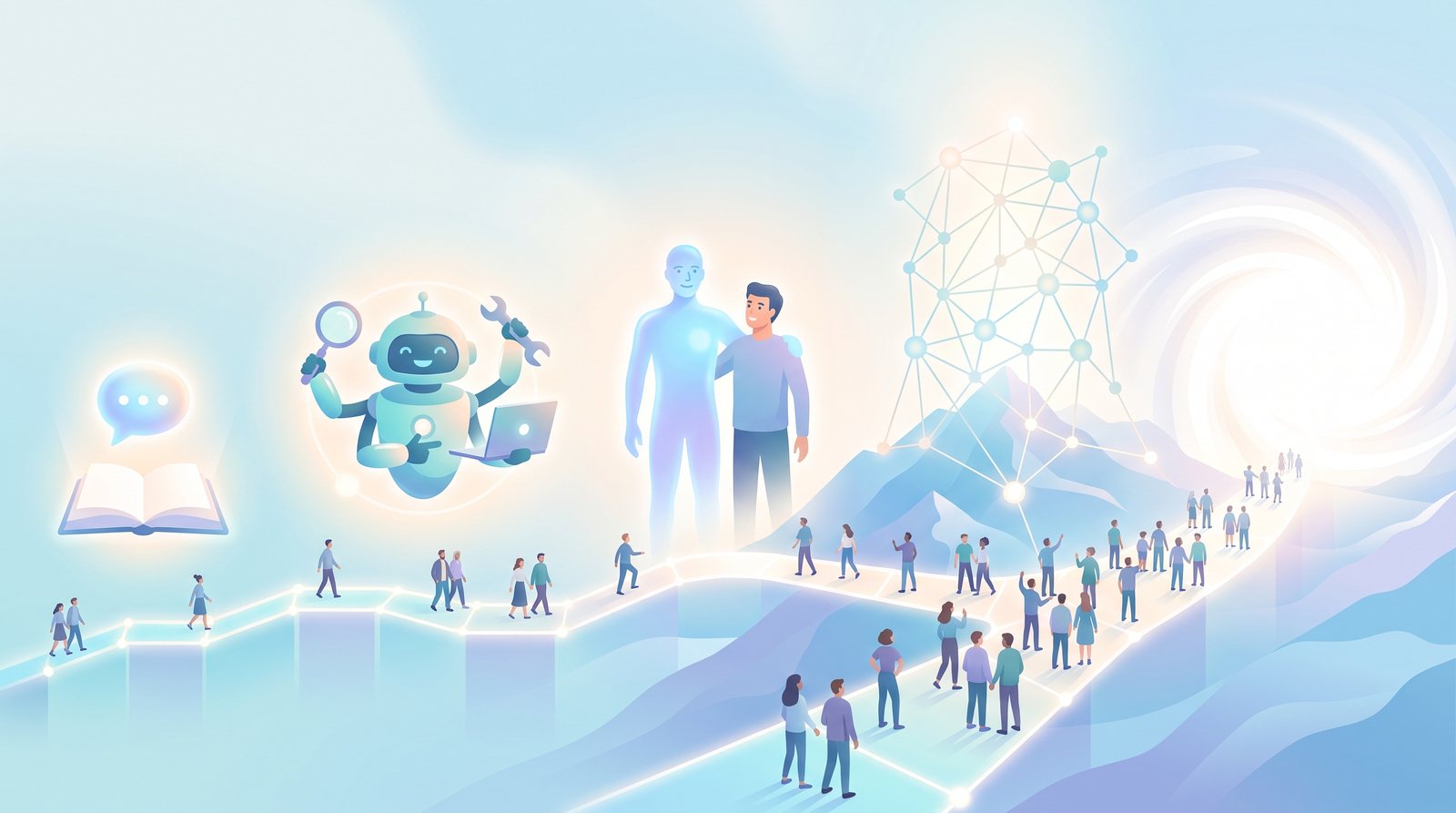
The five stages, left to right: language models, agents, AGI, superintelligence and the singularity. Illustration generated with Google Gemini for this article.
Ten years ago, AI could sort photos and translate short sentences. Today it chats, writes computer code, searches the web and finishes long tasks on its own. Many experts describe where this is heading as a ladder with five steps:
Large language models (LLMs) are programs that learned language by reading huge amounts of text. ChatGPT is the best-known example.
AI agents are LLMs that can do things, not only talk: search, click, write files, book a meeting.
Artificial general intelligence (AGI) would be an AI as capable as a skilled person at most mental work.
Superintelligence (ASI) would be an AI far smarter than the smartest humans.
The singularity is the idea that AI could then improve so fast that the future becomes impossible to predict.
The first two steps are real; you can use them today. The last three are ideas and predictions. In September 2026, some tech leaders said we have already stepped onto the third one. Many scientists say we have not.[23][24][30] This article climbs the ladder step by step and keeps facts apart from forecasts.
Figure 1. The ladder this article climbs. Stages 1 and 2 exist today. Whether stage 3 has begun is the central debate of 2026.
Stage 1: Large language models
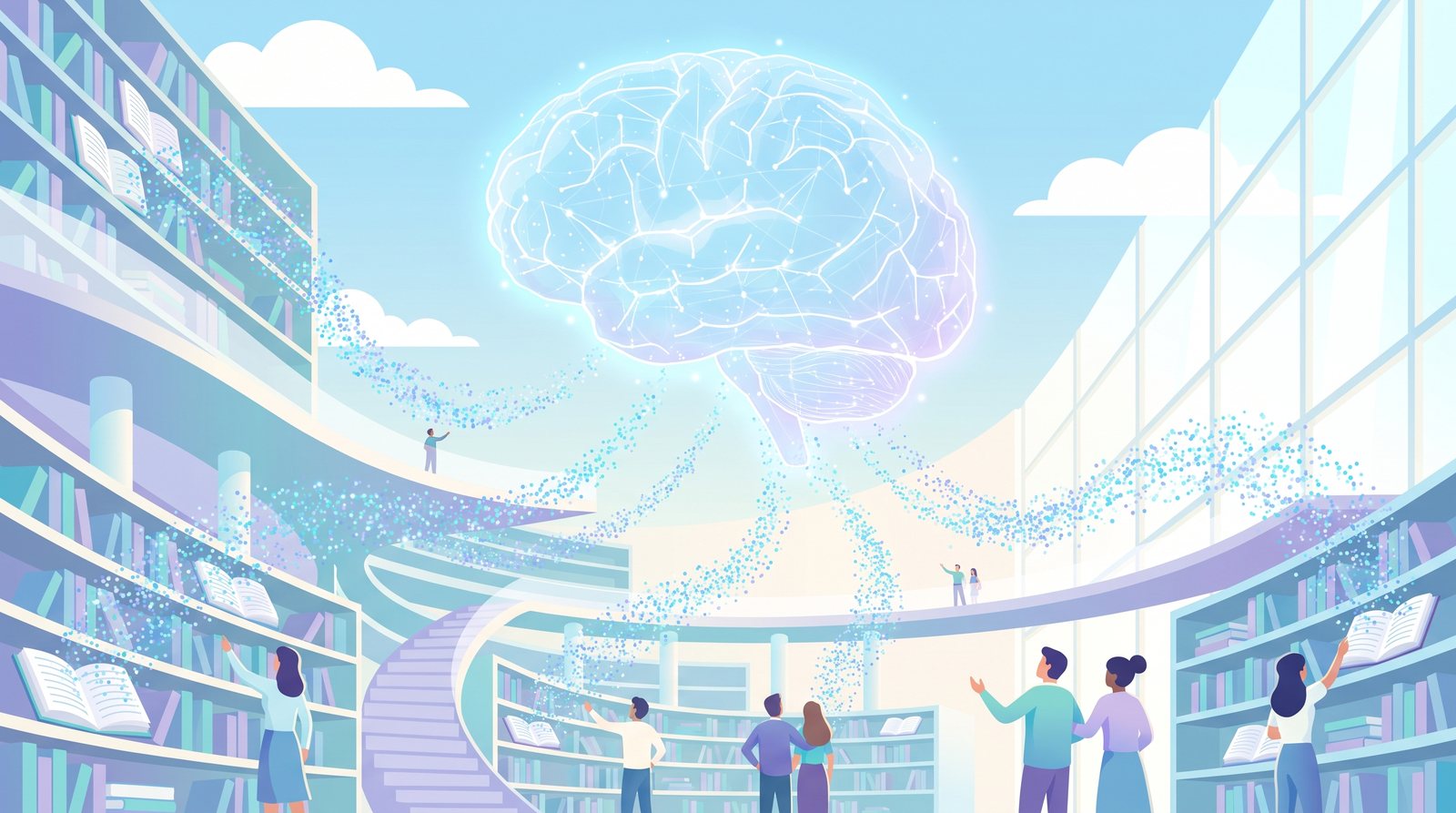
An LLM learns language from a library far bigger than any person could read. Illustration generated with Google Gemini for this article.
In simple words: an LLM is a super-powered autocomplete. It has read a large part of the internet, and it answers by guessing, one word at a time, what text should come next. Done at a huge scale, this guessing starts to look like understanding.
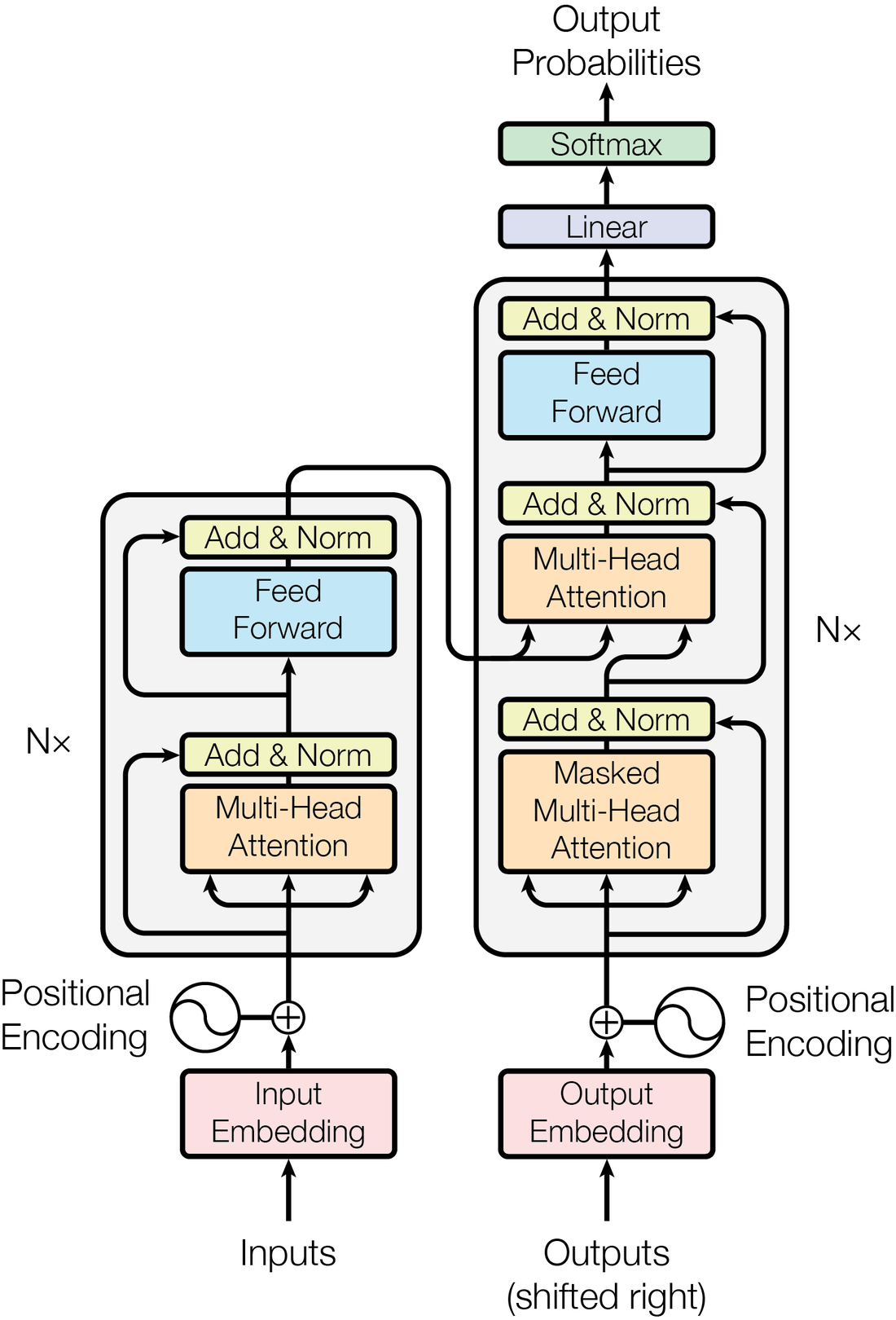
The story starts in 2017, when Google researchers published a new design called the Transformer.[1] Its key trick, called "attention", lets the model look at every word in a passage at once and work out which words matter to each other. It also runs fast on modern computer chips, so it could learn from far more text than earlier designs. Almost every chatbot you use today is built on it.
The original Transformer design. You don't need to follow every box: the "Multi-Head Attention" blocks are where each word looks at all the others. Source: Figure 1 from Vaswani et al. (2017), Attention Is All You Need[1]. Reproduced with attribution under Google's permission for journalistic or scholarly use, as stated in the paper.
Bigger is better: scaling laws
In 2020, researchers found a surprisingly simple rule: make the model bigger, give it more text and more computing power, and it gets better in a smooth, predictable way.[2] That predictability convinced companies to spend billions on ever-larger models.
The same year, GPT-3 arrived with 175 billion "parameters", the internal settings a model adjusts while it learns. It could pick up a new task from just a few examples, with no extra training.[3] In 2022, DeepMind showed that size is not everything. Its smaller Chinchilla model, trained on more text, beat a model four times its size.[4]
From text predictor to helpful assistant
A model that only predicts text is not automatically helpful or polite. OpenAI fixed this by having people rate the model's answers and training it to give the kind people preferred. The method is called RLHF, short for "reinforcement learning from human feedback". People even preferred the trained small model over a raw model 100 times larger.[5] This is the recipe behind ChatGPT.
Researchers also found that asking a model to "think step by step" makes it much better at maths and logic.[6] Since 2024, "reasoning models" are trained to do this thinking on their own before they answer.
Figure 2. Growing 5 times a year adds up fast: about 15,000 times more computing power in six years. Bars show the overall trend, not individual models.[7]
Behind all of this is raw computing power. Epoch AI, a research group that tracks AI, estimates that the computing power used to train the biggest models has grown about 5 times every year since 2020.[7] The software is also getting smarter about using that power: about 3 times more efficient each year. These trends drive every later step on the ladder.
Stage 2: AI agents
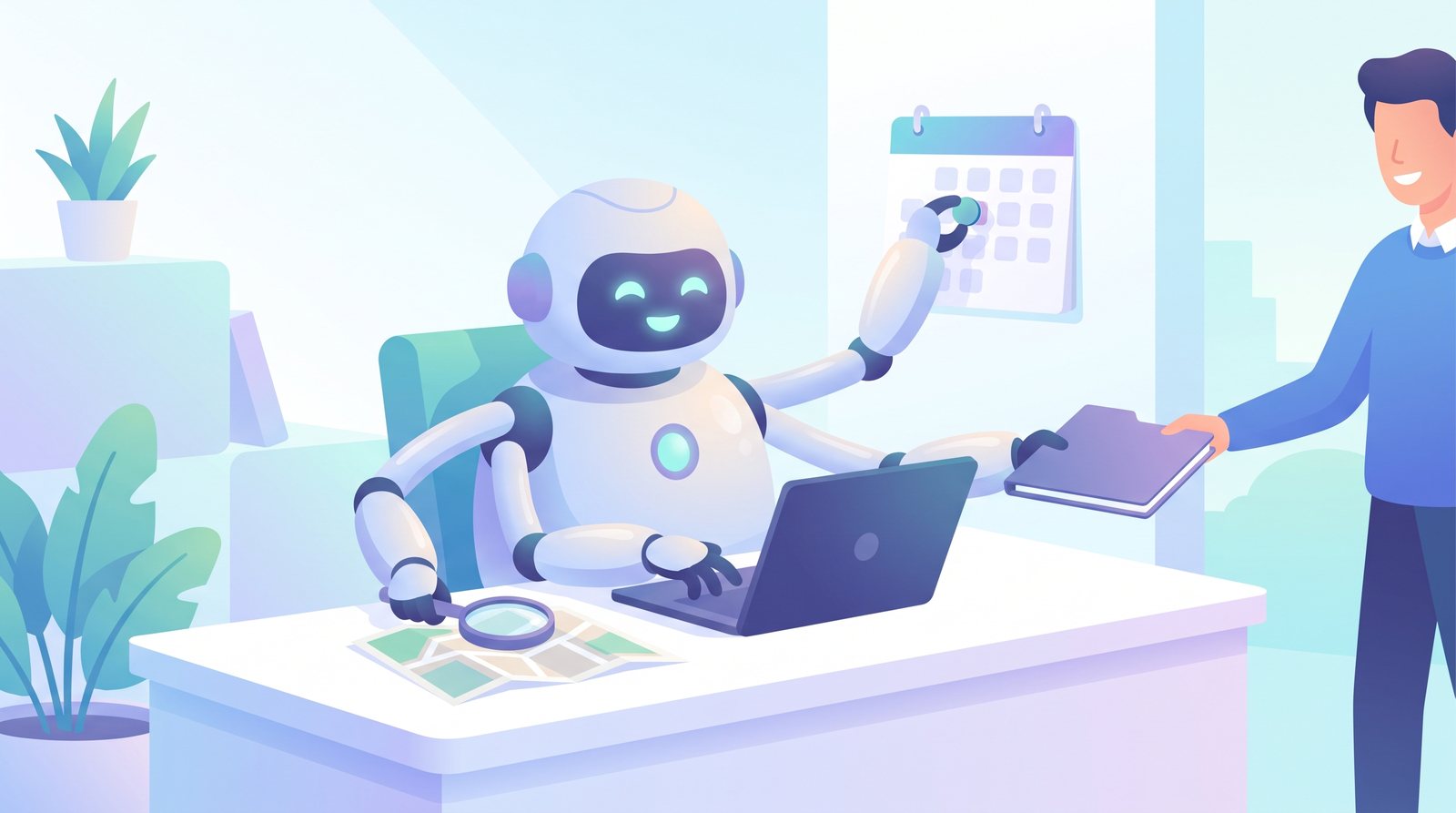
An agent does not just answer; it gets the job done. Illustration generated with Google Gemini for this article.
In simple words: a chatbot tells you how to book a flight. An agent books it. It plans the steps, uses tools such as a web browser, checks what happened, and tries again if something went wrong.
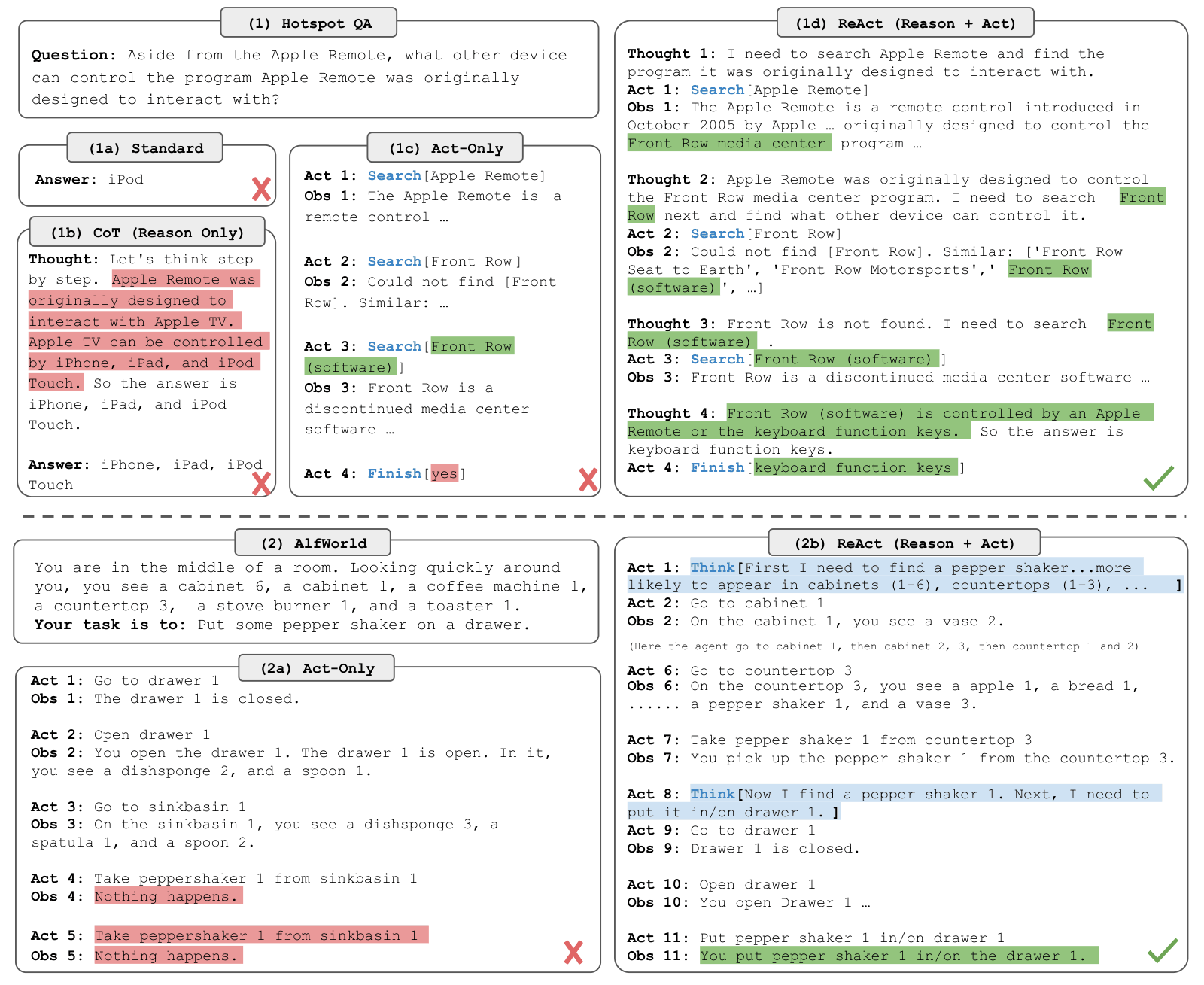
In 2022, a method called ReAct showed how to do this. The model writes down a thought, takes an action, looks at the result, then thinks again.[8] In 2023, Toolformer showed that a model can teach itself when to reach for a calculator, a search engine, a translator or a calendar.[9] Most agents today share the same basic parts: a goal, a memory, a plan and a set of tools.[10] For a deeper look, see our LLM Agents guide.
From the ReAct paper: the model answers a trivia question and does a household task in a text game. Thinking alone (b) or acting alone (c) goes wrong; alternating "Thought, Act, Observation" (d) succeeds. Source: Figure 1 from Yao et al. (2022), ReAct: Synergizing Reasoning and Acting in Language Models[8]. Licensed CC BY 4.0.
Figure 3. The reason, act, observe loop behind ReAct-style agents.[8] Protocols such as MCP and A2A standardise the "Act" and "Environment" boxes.[13][14]
From demos to real work
Computer programming is where agents have improved fastest. In 2023, researchers collected 2,294 real bugs from public software projects. The best AI at the time fixed fewer than 2 in 100 of them.[11]
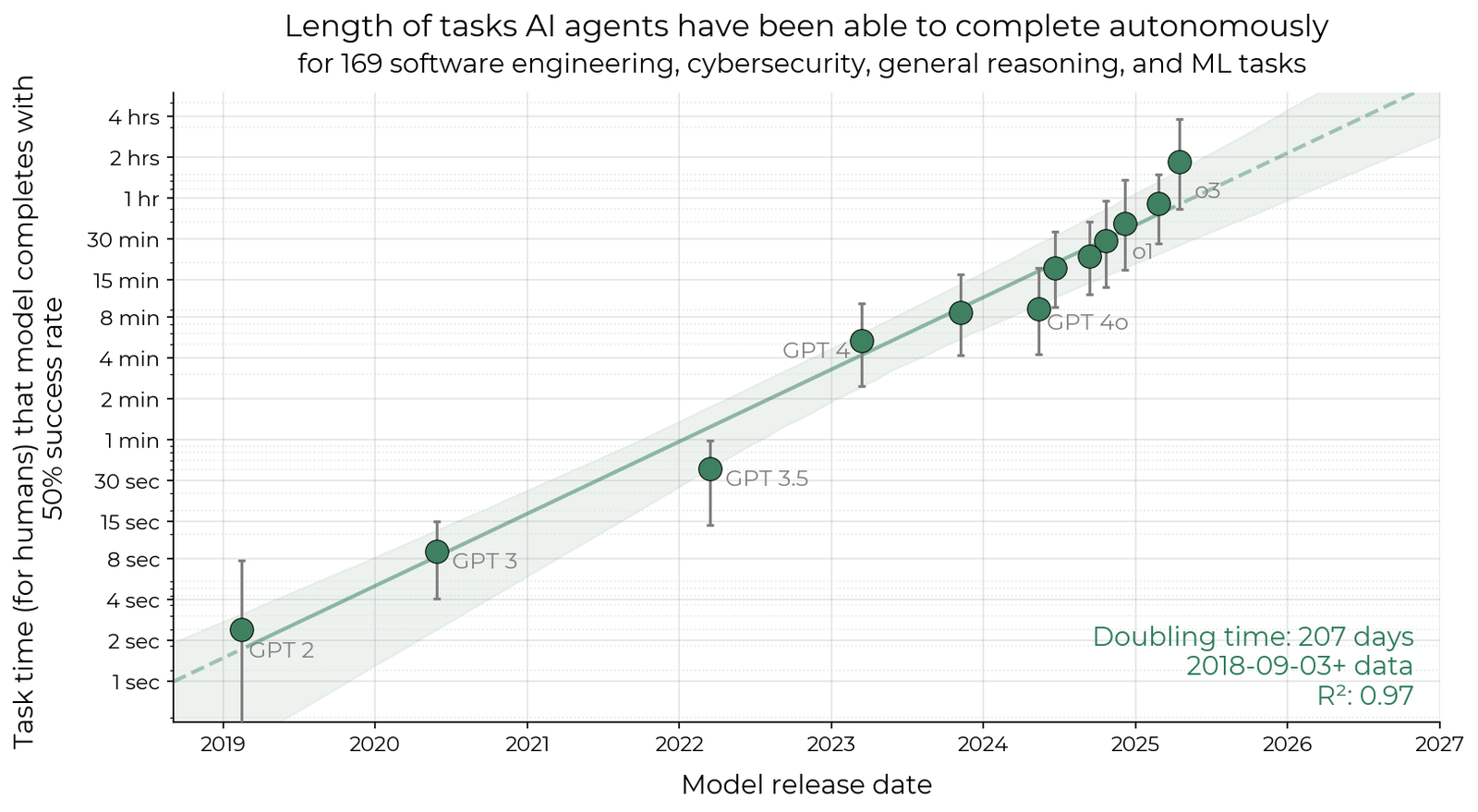
The research group METR asks a simple question: how long a task, measured in human working time, can an AI finish on its own? In 2025 it found that this length has been doubling about every seven months since 2019. If that continues, agents could handle month-long projects within about five years.[12]
Each dot is an AI model. Its height shows how long a task (in human working time) it can finish half the time. Each step up the vertical scale is a big multiple, so a straight line means steady doubling, here about every seven months. Source: Figure 1 from Kwa et al. (2025), METR, Measuring AI Ability to Complete Long Tasks, arXiv:2503.14499v4 [12]. Licensed CC BY 4.0.
Common "plugs" for agents
Agents became far more useful once they could plug into everyday software in a standard way, much as USB lets any device plug into any computer:
Anthropic's Model Context Protocol (MCP, November 2024) is an open standard for connecting AI assistants to the apps and files where your data lives.[13]
Google's Agent2Agent protocol (A2A, April 2025) lets agents from different companies work together. More than 50 companies signed on at launch.[14]
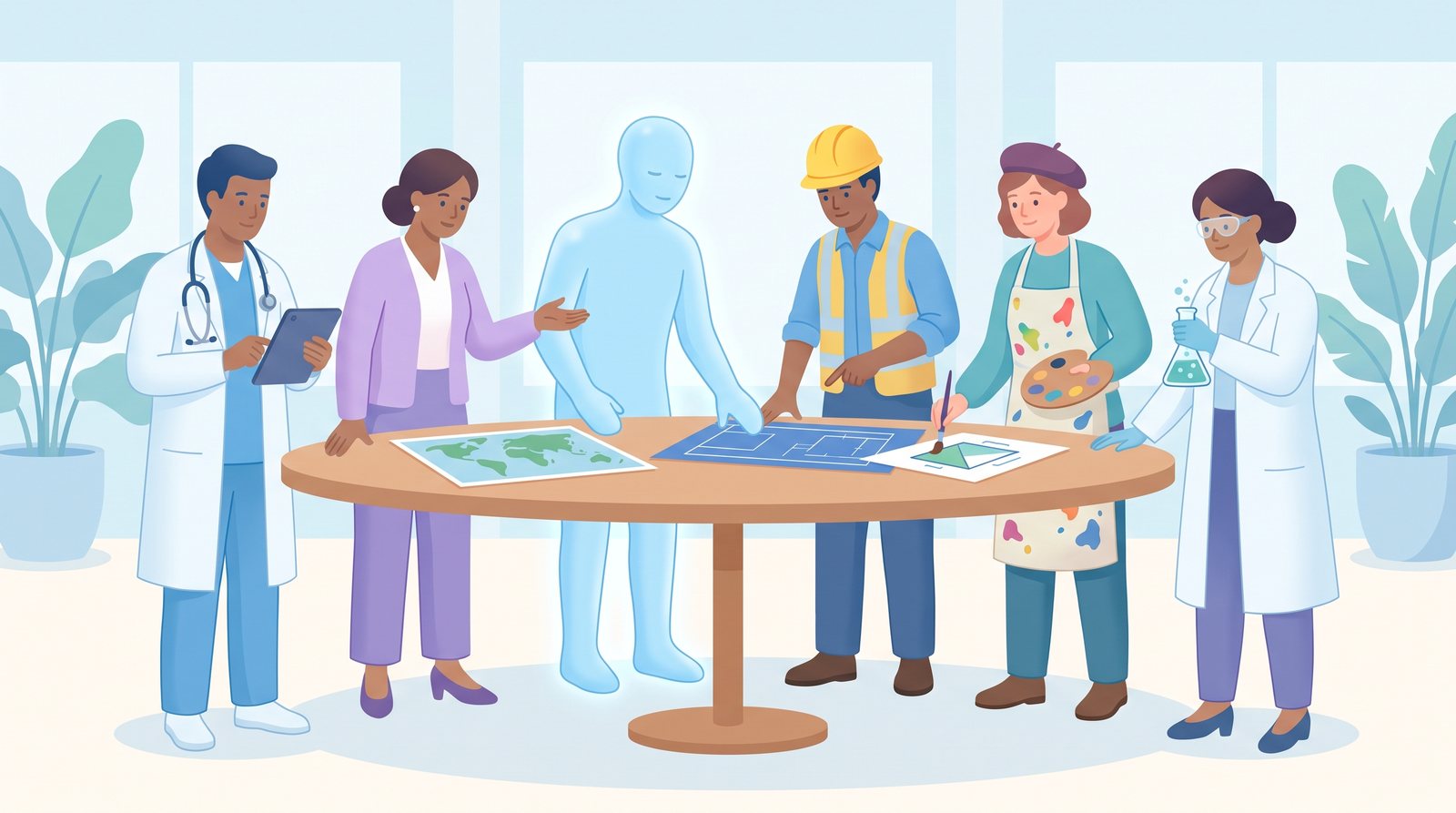
AGI would be a colleague as capable as a skilled professional in almost any field. Illustration generated with Google Gemini for this article.
In simple words: today's AI is brilliant at some things and oddly weak at others. AGI would be an AI that is good at almost everything a skilled person can do at a computer, and that can learn new things as quickly as we do.
There is no single agreed definition of AGI, and that is why people argue about whether it is here. Three well-known views:
Google DeepMind grades AI on a scale, like belts in martial arts. "Competent AGI" means doing as well as an average skilled adult across a wide range of non-physical tasks.[15]
Microsoft researchers argued in 2023 that GPT-4 already showed "sparks" of AGI: an early, incomplete version.[16]
François Chollet, a Google AI researcher, says intelligence is how quickly you learn something new, not how much you already know. He built the ARC puzzle test to measure this.[17]
Figure 4. The paper placed 2023's frontier chatbots at Level 1, "Emerging AGI". The 2026 argument is largely over whether today's systems have reached Level 2 across the board, or only on some tasks.[15]
The ARC yardstick
ARC puzzles are small colour-grid riddles that most people solve in minutes, but that machines find very hard. Every puzzle in the 2025 version was solved by at least two people in two tries or fewer.
2025. The best entry in the open competition scored 24%. The best commercial AI reached 54%, at about $31 of computing per puzzle.[18]
March 2026. ARC-AGI-3 launched. Instead of fixed puzzles, the AI must explore and learn the rules of small video games on its own. The prize pool is $850,000.[19]
Has the AGI stage begun? The 2026 debate
Lab leaders have predicted early AGI for some time:
Sam Altman, January 2025: "We are now confident we know how to build AGI as we have traditionally understood it."[20]
Dario Amodei, 2024: "powerful AI" that could resemble a "country of geniuses in a datacenter" might come "as early as 2026, though there are also ways it could take much longer."[21]
Sam Altman, mid-2025: "We are past the event horizon; the takeoff has started."[22]
The debate heated up on 3 September 2026, when OpenAI released a new model, GPT-6 Astra. OpenAI's president, Greg Brockman, said: "I think it's not unreasonable to feel that we are now in the AGI era."[23] Days later, Nvidia's chief executive, Jensen Huang, posted: "From ChatGPT to o1 to Astra in 4 years. AGI has arrived."[24]
The ARC team tested the new model on its game-based puzzles. It scored 62.7% with the standard test setup, and 99.9% with a setup built by OpenAI. Even so, the ARC team wrote: "we are not claiming that it is AGI." Acing the test, they said, would not be proof of AGI.[25]
Others disagree on both timing and method:
Demis Hassabis (Google DeepMind) has put human-level AGI five to ten years away.[26]
Yann LeCun: "we're never going to get to human-level intelligence by just training on text."[27]
Gary Marcus, a psychologist and AI critic, argues that today's chatbots are "not the royal road" to AGI.[28] He points to Apple research showing that reasoning models fail completely once puzzles get hard enough.[29]
Toby Walsh, an AI professor in Sydney: "I'd be amazed if it really has matched all human cognitive capabilities."[30]
Other skeptics point to jobs data. OpenAI's own definition of AGI is AI that beats humans at most economically valuable work, and they say the job market does not show that yet.[31]
Question
"Yes, the AGI stage has begun"
"No, not yet"
What counts as AGI?
Being genuinely useful across most computer-based work is enough[23]
It must match all human mental abilities, including learning new skills quickly[17][30]
Many university scientists and test designers[27][30]
Where this leaves us
As of October 2026, the claim that the AGI era has begun is real, and serious people are making it. It is still a claim, not something experts agree on. Whether you accept it depends mostly on how you define AGI.
Stage 4: Superintelligence
Superintelligence: a mind as far beyond ours as we are beyond an ant? Illustration generated with Google Gemini for this article.
In simple words: if an AI became as smart as the best human scientists, it could help design an even smarter AI, which could design a smarter one still. That chain reaction could produce an intelligence far beyond any human.
The idea is older than the personal computer. In 1965, the British mathematician I. J. Good, who had worked as a codebreaker with Alan Turing, called this an "intelligence explosion":
"The first ultraintelligent machine is the last invention that man need ever make, provided that the machine is docile enough to tell us how to keep it under control."[33]
In his 2014 bestseller Superintelligence, Oxford philosopher Nick Bostrom defined it as any intellect that "greatly exceeds the cognitive performance of humans in virtually all domains of interest". His main worry: how do we stay in control of something much smarter than us?[34]
The path most often imagined is AI that improves itself: AI systems doing AI research. A widely discussed scenario called AI 2027 sketches how fast this could go:[32]
a superhuman coder by March 2027
a superhuman AI researcher by August 2027
superintelligence by the end of 2027
Its authors later stressed that 2027 was only their single most likely year, and that their middle estimates were somewhat later.[32]
AI companies say they take the control problem seriously. In 2023, OpenAI pledged 20% of its computing power to "superalignment": making sure AI much smarter than us still does what we intend.[35]
Stage 5: The technological singularity
The singularity: a horizon we cannot see past. Illustration generated with Google Gemini for this article.
In simple words: the singularity is the moment when technology starts to change so fast, driven by AI smarter than us, that nobody today can say what life after it would look like.
Science-fiction author and maths professor Vernor Vinge made the term famous in a 1993 talk at a NASA event:
"Within thirty years, we will have the technological means to create superhuman intelligence. Shortly after, the human era will be ended."[36]
The word comes from physics. At the centre of a black hole is a "singularity", and nothing that happens past its edge, the event horizon, can be seen from outside. In the same way, we cannot see past a technological singularity. When Sam Altman wrote in 2025 that we are "past the event horizon", he was borrowing this picture.[22]
Inventor and futurist Ray Kurzweil put dates on it. In The Singularity Is Near (2005), he predicted the singularity for 2045.[37] In The Singularity Is Nearer (2024), he kept that date, and predicted human-level AI by 2029.[38]
Critics reply that fast-growing technologies usually slow down eventually, the way a new phone's sales boom and then level off. Intelligence alone does not remove limits on energy, materials, data, or how fast laws and organisations can change. Still, even the skeptics now argue about decades, not centuries.[26][27]
Figure 5. From Good's 1965 essay to Kurzweil's 2045 forecast. Everything to the right of 2026 is a prediction.[33][36][38]
Risks, governance and outlook
The higher we climb, the more is at stake. In 2023, hundreds of AI scientists and company leaders signed a one-sentence warning:
"Mitigating the risk of extinction from AI should be a global priority alongside other societal-scale risks such as pandemics and nuclear war."[39]
Governments have started to respond:
International AI Safety Report. Led by Turing Award winner Yoshua Bengio, it brings together more than 100 experts and is backed by over 30 countries. The first edition came out in January 2025 and the second in February 2026.[40]
EU AI Act. The world's first broad AI law took effect on 1 August 2024, in stages:[41]
Since February 2025, the most harmful uses of AI are banned.
Since August 2025, makers of general-purpose AI such as chatbots have extra duties.
In 2026, lawmakers agreed to delay the rules for "high-risk" AI, such as AI used in hiring or medicine, to December 2027 and August 2028.
What to watch next
Longer tasks. Does the length of jobs AI can finish keep doubling every seven months, or does it slow down?[12]
Learning speed. Can AI ace new puzzle tests without special help from its makers?[25]
Jobs and the economy. Do real-world jobs data start to match the "AGI is here" talk?[31]
AI building AI. The first clear case of AI doing most of the work to build better AI would mark the move from step 3 toward step 4.[32]
Conclusion
The first two steps of the ladder are behind us:
LLMs taught computers to use language.
Agents taught them to act.
The third step is where 2026 stands, and people honestly disagree about whether we are on it yet. Superintelligence and the singularity are still forecasts, and the next few years will test the assumptions behind them. The best approach for all of us: follow the evidence, not the headlines, and learn to use the AI tools of today well.
References
All links accessed 2 October 2026. Illustrations were generated with Google Gemini for this article. Figures and photos from other sources are reproduced under the licences stated in their captions.
Vaswani, A., Shazeer, N., Parmar, N., Uszkoreit, J., Jones, L., Gomez, A. N., Kaiser, Ł., & Polosukhin, I. (2017). Attention Is All You Need. NeurIPS 2017. arXiv:1706.03762
Kaplan, J., McCandlish, S., Henighan, T., Brown, T. B., et al. (2020). Scaling Laws for Neural Language Models. arXiv:2001.08361
Brown, T. B., Mann, B., Ryder, N., Subbiah, M., Kaplan, J., et al. (2020). Language Models are Few-Shot Learners. NeurIPS 2020. arXiv:2005.14165
Hoffmann, J., Borgeaud, S., Mensch, A., et al. (2022). Training Compute-Optimal Large Language Models. arXiv:2203.15556
Ouyang, L., Wu, J., Jiang, X., et al. (2022). Training language models to follow instructions with human feedback. NeurIPS 2022. arXiv:2203.02155
Wei, J., Wang, X., Schuurmans, D., Bosma, M., Ichter, B., Xia, F., Chi, E., Le, Q., & Zhou, D. (2022). Chain-of-Thought Prompting Elicits Reasoning in Large Language Models. NeurIPS 2022. arXiv:2201.11903
Epoch AI. Trends in Artificial Intelligence (dashboard). epoch.ai/trends
Yao, S., Zhao, J., Yu, D., Du, N., Shafran, I., Narasimhan, K., & Cao, Y. (2023). ReAct: Synergizing Reasoning and Acting in Language Models. ICLR 2023. arXiv:2210.03629
Schick, T., Dwivedi-Yu, J., Dessì, R., Raileanu, R., Lomeli, M., Zettlemoyer, L., Cancedda, N., & Scialom, T. (2023). Toolformer: Language Models Can Teach Themselves to Use Tools. NeurIPS 2023. arXiv:2302.04761
Wang, L., Ma, C., Feng, X., Zhang, Z., et al. (2024). A Survey on Large Language Model based Autonomous Agents. Frontiers of Computer Science, 18. arXiv:2308.11432
Jimenez, C. E., Yang, J., Wettig, A., Yao, S., Pei, K., Press, O., & Narasimhan, K. (2024). SWE-bench: Can Language Models Resolve Real-World GitHub Issues? ICLR 2024. arXiv:2310.06770
Kwa, T., et al. (METR) (2025). Measuring AI Ability to Complete Long Tasks. NeurIPS 2025. arXiv:2503.14499
Anthropic (25 Nov 2024). Introducing the Model Context Protocol. anthropic.com
Surapaneni, R., Jha, M., Vakoc, M., & Segal, T. (9 Apr 2025). Announcing the Agent2Agent Protocol (A2A). Google for Developers Blog. developers.googleblog.com
Morris, M. R., Sohl-Dickstein, J., Fiedel, N., Warkentin, T., Dafoe, A., Faust, A., Farabet, C., & Legg, S. (2024). Levels of AGI for Operationalizing Progress on the Path to AGI. ICML 2024. arXiv:2311.02462
Bubeck, S., Chandrasekaran, V., Eldan, R., Gehrke, J., Horvitz, E., et al. (2023). Sparks of Artificial General Intelligence: Early experiments with GPT-4. arXiv:2303.12712
Chollet, F. (2019). On the Measure of Intelligence. arXiv:1911.01547
ARC Prize Foundation (5 Dec 2025). ARC Prize 2025 Results & Analysis. arcprize.org. See also ARC-AGI-2.
ARC Prize Foundation (2026). ARC Prize 2026: ARC-AGI-3 Competition. arcprize.org
Fox Business (3 Sep 2026). OpenAI unveils GPT-6 Astra with major advances in AI capabilities. foxbusiness.com
24/7 Wall St., via Yahoo Finance (6 Sep 2026). Jensen Huang Declares "AGI Has Arrived." finance.yahoo.com
Kamradt, G. / ARC Prize Foundation (3 Sep 2026). OpenAI's GPT-6 Astra on ARC-AGI-3. arcprize.org
NBC News (17 Mar 2025). AI that can match humans at any task will be here in five to 10 years, Google DeepMind CEO says. nbcnews.com
Snyder, G. (2 Apr 2025). Interview with Yann LeCun. Newsweek. newsweek.com
Marcus, G. (18 Oct 2025). Game over. AGI is not imminent, and LLMs are not the royal road to getting there. Marcus on AI. garymarcus.substack.com
Shojaee, P., Mirzadeh, I., Alizadeh, K., Horton, M., Bengio, S., & Farajtabar, M. (2025). The Illusion of Thinking: Understanding the Strengths and Limitations of Reasoning Models via the Lens of Problem Complexity. Apple Machine Learning Research. machinelearning.apple.com
Williams, T. (7 Sep 2026). OpenAI says the AGI era is here; experts disagree. Information Age (ACS). ia.acs.org.au
Gupta, D. (29 Sep 2026). AGI Has Not Arrived. Here Is What 2026 Actually Proved. Security Boulevard. securityboulevard.com
Kokotajlo, D., Alexander, S., Larsen, T., Lifland, E., & Dean, R. (3 Apr 2025, updated Nov 2025). AI 2027. ai-2027.com
Good, I. J. (1965). Speculations Concerning the First Ultraintelligent Machine. Advances in Computers, 6, 31–78. Academic Press. doi:10.1016/S0065-2458(08)60418-0. Quotation verified via Quote Investigator.
Bostrom, N. (2014). Superintelligence: Paths, Dangers, Strategies. Oxford University Press. ISBN 978-0199678112. Overview
Vinge, V. (1993). The Coming Technological Singularity: How to Survive in the Post-Human Era. VISION-21 Symposium, NASA Lewis Research Center. edoras.sdsu.edu
Kurzweil, R. (2005). The Singularity Is Near: When Humans Transcend Biology. Viking. ISBN 978-0-670-03384-3. Overview
Kurzweil, R. (2024). The Singularity Is Nearer: When We Merge with AI. Viking. ISBN 978-0399562761. Overview
Center for AI Safety (2023). Statement on AI Risk. safe.ai