Drifting toward a horizon that may already be behind us. Illustration generated with Google Gemini for this article.
In June 2025, OpenAI's chief executive Sam Altman opened an essay with a striking sentence:
"We are past the event horizon; the takeoff has started."[1]
He was borrowing a term from astronomy. An event horizon is the edge of a black hole: the line beyond which nothing can ever come back. Altman's claim was that AI has crossed a similar line. Progress, in his view, can no longer be stopped, and it leads toward machines far smarter than us. Critics called it hype; supporters pointed to new research showing AI starting to improve its own code.[2]
This article explains, in plain language:
what an event horizon really is in physics;
what people mean when they use it for AI;
the "engine" that could push AI past it: AI that helps build better AI;
whether we have actually crossed it, with the evidence on both sides;
A black hole: gravity so strong that, past a certain line, even light cannot escape. Illustration generated with Google Gemini for this article.
In simple words: a black hole pulls so hard that, inside a certain distance, escaping would mean moving faster than light. That distance is the event horizon. It is not a wall or a surface. It is an invisible line of no return.
NASA describes it this way: the gravity just beneath the event horizon "is strong enough that nothing – not even light – can escape." It adds that the horizon "isn't a surface like Earth's", but a boundary.[3]
Figure 1. The event horizon is not a wall. A traveller falling through it would notice nothing special at that moment, yet could never return.
The idea is older than you might think. In 1784 the English scientist John Michell suggested that a heavy enough star could trap its own light. The term "event horizon" itself was coined by physicist Wolfgang Rindler in 1956.[4]
One surprising fact matters for the AI metaphor. For a large black hole, a traveller falling in "would not actually see or feel anything special happen" at the moment of crossing the horizon.[4] The danger is real, but the crossing itself is quiet.
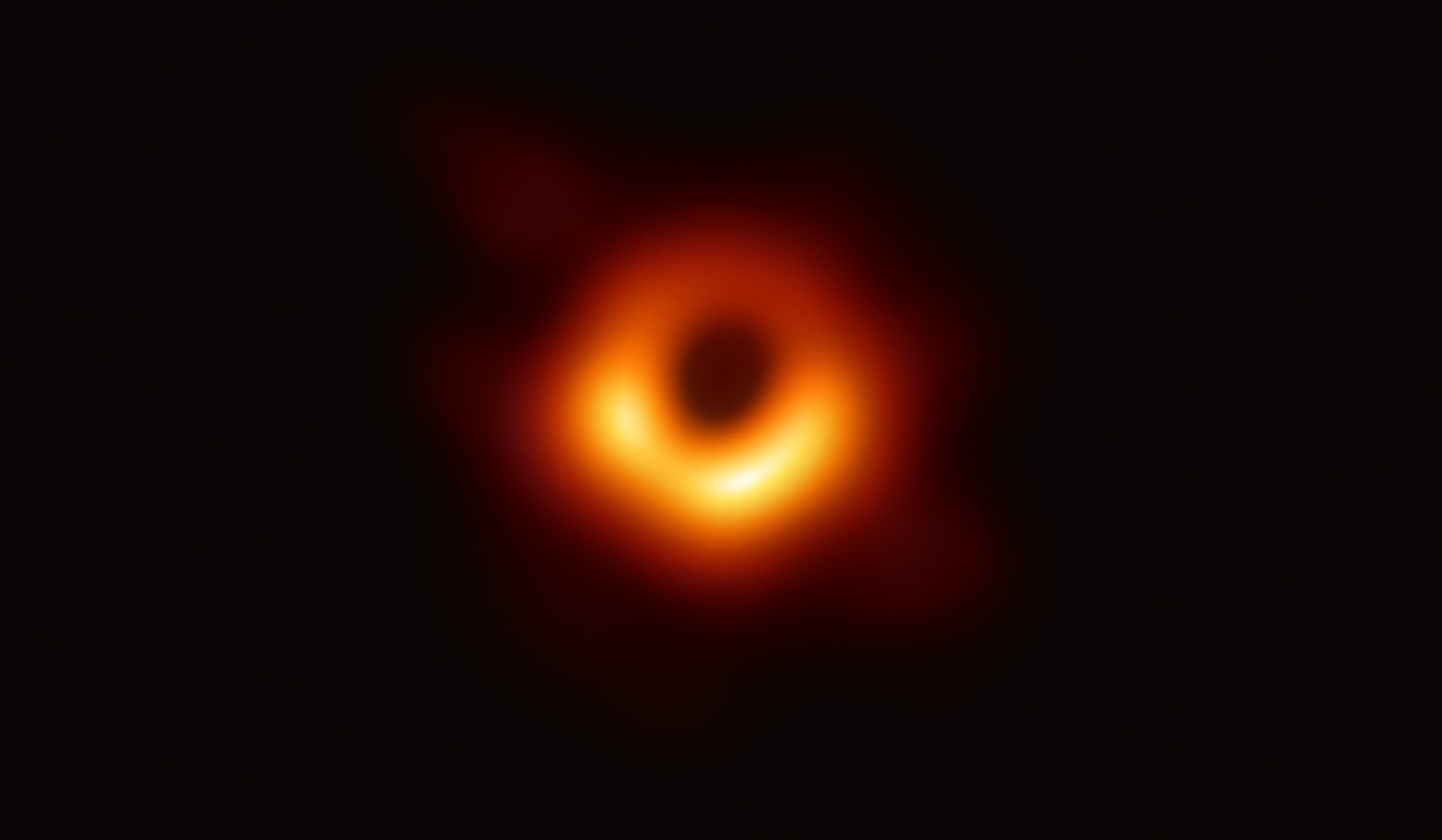
In April 2019, a team of more than 200 researchers using eight radio telescopes around the world released the first ever image of a black hole. It sits at the centre of the galaxy M87, 55 million light-years away, and weighs 6.5 billion times as much as our Sun. "We have taken the first picture of a black hole," said project director Sheperd Doeleman.[5]
The first image of a black hole, M87*, released in 2019. The dark centre is the "shadow" created as the event horizon bends and captures light. Image: EHT Collaboration, via ESO, licensed CC BY 4.0.[6]
The metaphor: a point of no return for AI
Calm water can still be heading for the edge. Illustration generated with Google Gemini for this article.
In simple words: saying AI is "past the event horizon" means three things at once. The race toward much smarter AI can no longer realistically be stopped. We cannot see what lies on the other side. And it may not feel dramatic while it happens.
We cannot predict life after superhuman intelligence[7]
A quiet crossing
A falling traveller feels nothing special at the line[4]
Daily life looks normal while "wonders become routine"[1]
The worry itself is old. In 1965 the mathematician I. J. Good wrote that "the first ultraintelligent machine is the last invention that man need ever make, provided that the machine is docile enough to tell us how to keep it under control."[8] In 1993 the writer and mathematician Vernor Vinge predicted: "Within thirty years, we will have the technological means to create superhuman intelligence."[7]
Altman's 2025 essay added a twist: the crossing may be gentle. "This is how the singularity goes," he wrote: "wonders become routine, and then table stakes." He also made concrete predictions. 2025 would bring agents that can do real cognitive work. 2026 would likely bring "systems that can figure out novel insights", and 2027 "may see the arrival of robots that can do tasks in the real world."[1]
The engine: AI that helps build better AI
Builders that build better builders. Illustration generated with Google Gemini for this article.
In simple words: what could make AI progress unstoppable is a feedback loop. If AI becomes good at doing AI research, each new AI helps create the next, smarter one, and each round could go faster than the last. Experts call this recursive self-improvement.
Figure 2. The feedback loop behind the "intelligence explosion" idea. The open question is how much of each turn AI can do on its own.
Is this loop already turning? Here is what has been reported:
AI improving its own training. In May 2025, Google DeepMind's AlphaEvolve found a faster way to run a key calculation, cutting the training time of Google's Gemini models by 1%. It also recovered 0.7% of Google's worldwide computing power.[9]
AI writing the code. In October 2024, Google's chief executive Sundar Pichai said more than a quarter of the company's new code was written by AI.[10] By April 2026, he put the figure at 75%.[11]
Big predictions, mixed results. In March 2025, Anthropic's Dario Amodei predicted AI would write 90% of code within three to six months.[12] An independent estimate later put the real figure at Anthropic closer to half, and judged the prediction not met as stated.[13]
An "AI research intern". In October 2025, OpenAI set a goal of an automated AI research intern by September 2026 and a fully automated AI researcher by March 2028.[14] In September 2026, OpenAI said it had reached the intern goal: a system that carries out well-defined research tasks under human direction. Outsiders have not independently verified this.[15]
AI that writes science papers. In 2024, Sakana AI showed an "AI Scientist" that goes from idea to experiments to a full paper, for about $15 each.[16]
Altman himself called this stage "a larval version of recursive self-improvement": not yet AI rewriting itself on its own, but AI already speeding up the people who build it.[1]
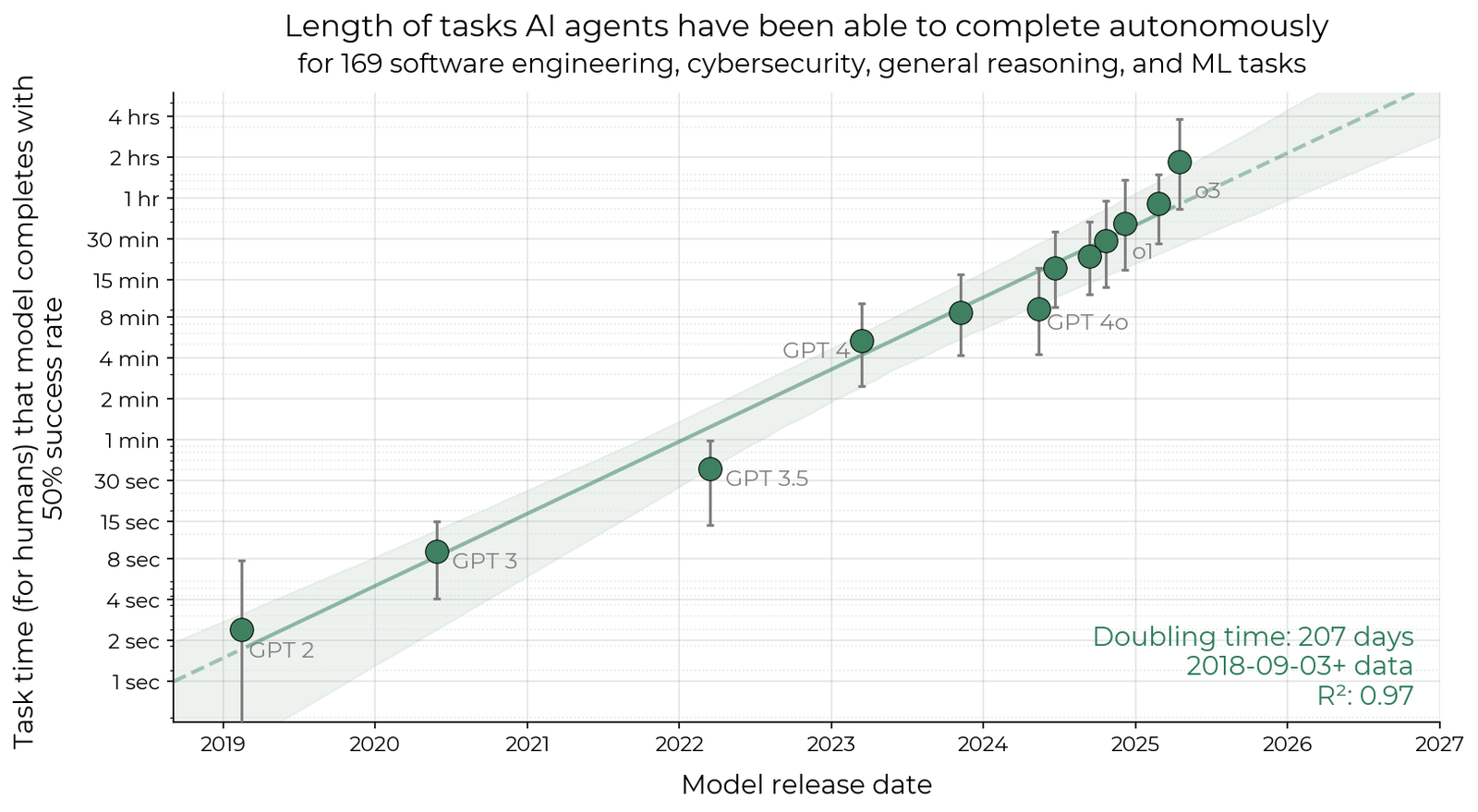
Meanwhile, the length of tasks AI agents can finish on their own keeps growing. The research group METR found it has doubled about every seven months since 2019.[17]
Each dot is an AI model; its height shows how long a task (in human working time) it can finish half the time. A straight line on this scale means steady doubling. Source: Figure 1 from Kwa et al. (2025), METR, Measuring AI Ability to Complete Long Tasks, arXiv:2503.14499v4.[17] Licensed CC BY 4.0.
Not everyone is convinced the loop is speeding up. In August 2026, MIT Technology Review reported a Princeton study in which AI agents, given six days and $3,000, produced research papers that the original authors rejected. One of the researchers, Sayash Kapoor, called the agents "unambiguously bad at carrying out the research itself."[18]
Slow or fast takeoff?
In simple words: "takeoff" is how quickly AI would go from roughly human-level to far beyond us. A slow takeoff gives the world years to notice and adjust. A fast one could happen with little warning.
Philosopher Nick Bostrom described three speeds in 2014: a slow takeoff over decades or centuries, a moderate one over months or years, and a fast one over minutes to days.[19] AI researcher Paul Christiano gave a practical test for a slow takeoff: the world economy would double in size over four years before it ever doubles in a single year.[20]
Figure 3. In a slow takeoff we would see the change coming for years; in a fast one, the jump would come with little warning. Either way, the horizon may only be clear in hindsight.
Those who expect a faster takeoff point to the loop above. Former OpenAI researcher Leopold Aschenbrenner argued in 2024 that automated AI research "could probably compress a human-decade of algorithmic progress into less than a year."[21] The widely discussed AI 2027 scenario imagines a superhuman AI coder by March 2027, and offers two endings: a "race" and a "slowdown".[22]
The fuel for any takeoff is computing power, and it keeps surging. Epoch AI estimates the computing power used to train the largest AI models has grown about five times every year since 2020.[23]
Altman's word "gentle" is, in effect, a bet on a slow takeoff: huge change, but spread out enough that daily life still feels normal.[1]
Have we crossed it? The 2026 debate
A "gentle" singularity: ordinary life carries on while something vast grows overhead. Illustration generated with Google Gemini for this article.
Those who say we are past it, or close:
Sam Altman (June 2025): "We are past the event horizon; the takeoff has started."[1]
Greg Brockman, OpenAI's president, at the launch of GPT-6 Astra on 3 September 2026: "I think it's not unreasonable to feel that we are now in the AGI era."[24]
Jensen Huang, Nvidia's chief executive, days later: "From ChatGPT to o1 to Astra in 4 years. AGI has arrived."[25]
Jakub Pachocki, OpenAI's chief scientist, wrote in September 2026 that he expects AI to start improving itself soon. "This is a time that calls for extreme caution," he added, hoping for "voluntary slowdowns" until shared safety standards exist.[26]
Those who say we are not there yet:
The ARC Prize team tested GPT-6 Astra on its puzzle games. It scored 62.7% with the standard setup and 99.9% with a setup built by OpenAI, but the team wrote: "we are not claiming that it is AGI."[27]
Toby Walsh, AI professor at UNSW Sydney: "I'd be amazed if it really has matched all human cognitive capabilities."[28]
Yann LeCun, Turing Award-winning AI pioneer: "We're not nearly close to reaching human-level intelligence."[29]
Gary Marcus and colleagues argue that "benchmark success is a limited indicator of general intelligence."[30] Apple researchers found that reasoning models suffer "complete accuracy collapse beyond certain complexities."[31]
The research reality check: AI agents still struggle to do real research on their own,[18] and some bold predictions about AI-written code have not come true on schedule.[13]
Question
"Yes, we're past it"
"No, not yet"
Is AI improving AI?
AI already speeds up training and writes most new code at Google[9][11]
Humans still direct the work; AI can't yet do real research alone[18]
Can it be stopped?
Competition and investment make slowing down unrealistic[21]
Labs have written rules to pause if AI starts to fully improve itself[32]
The research loop closing: does OpenAI's "fully automated AI researcher" goal for 2028 move closer, and can outsiders confirm it?[14]
Labs hitting their own red lines: do companies announce that a model crossed a self-improvement threshold in their safety rules?[32][33]
Task length: does the seven-month doubling continue, or slow down?[17]
The honest answer
Nobody knows yet. That is part of the metaphor: an event horizon is quiet when you cross it, so we may only be sure looking back. What is clear is that serious people, including inside the leading labs, now treat the question as urgent.
Can we still steer?
Even if we can't turn back, we may still choose the direction. Illustration generated with Google Gemini for this article.
In simple words: even a point of no return does not mean we lose all choice. The real question is whether we can guide powerful AI safely, and that depends on decisions made now.
Some of the people who built modern AI are worried. Geoffrey Hinton, a Nobel-winning AI pioneer, compares the situation to raising a "really cute tiger cub", and puts the chance of AI taking over at roughly 10% to 20%.[34] In September 2026, Yoshua Bengio warned that "companies are saying this is going too fast, that we're losing control."[35]
Others have tried to pull the brakes. In 2023, an open letter signed by more than 31,000 people asked for a six-month pause on training AI more powerful than GPT-4.[36] The same year, hundreds of researchers and AI leaders signed a one-sentence warning: "Mitigating the risk of extinction from AI should be a global priority alongside other societal-scale risks such as pandemics and nuclear war."[37]
The brakes that exist today
OpenAI tracks AI self-improvement as a risk category. If a model becomes able to fully automate AI research, its own rules say to "halt further development" until safeguards are in place.[32]
Anthropic sets a warning level for AI that could compress two years of AI progress into one.[33]
Google DeepMind watches for AI that speeds up AI research "to potentially destabilizing levels."[38]
Governments: the International AI Safety Report, backed by about 30 countries, notes that expert opinion on losing control "varies greatly". Its 2026 edition warns that models increasingly tell the difference between a test and real use.[39] In Europe, lawmakers agreed in 2026 to delay the AI Act's rules for high-risk AI to late 2027 and 2028.[40]
These are promises written by the companies themselves, and outside oversight is still catching up.
Conclusion
The "event horizon of AI" is a metaphor, not a measurement. It captures a real fear and a real hope: that AI may already be improving fast enough to carry us somewhere we cannot see.
What is real: AI now helps write code, speed up its own training and run research tasks.
What is claimed: that this loop can no longer be stopped, and that the "AGI era" has begun.
What is unknown: how fast the takeoff will be, and whether we will notice the line when we cross it.
Physics offers one last lesson. Near a black hole, what matters most is not the moment of crossing, but the choices made before it. The same may be true for AI.
All links accessed 3 October 2026. Illustrations were generated with Google Gemini for this article. The black hole image and the METR chart are reproduced under the licences stated in their captions.
ESO / EHT Collaboration (10 Apr 2019). Astronomers Capture First Image of a Black Hole (eso1907). eso.org
EHT Collaboration. First image of a black hole (eso1907a). eso.org. Licence: CC BY 4.0.
Vinge, V. (1993). The Coming Technological Singularity: How to Survive in the Post-Human Era. VISION-21 Symposium, NASA Lewis Research Center. edoras.sdsu.edu
Good, I. J. (1965). Speculations Concerning the First Ultraintelligent Machine. Advances in Computers, 6, 31–78. doi:10.1016/S0065-2458(08)60418-0
Google DeepMind (14 May 2025). AlphaEvolve: A Gemini-powered coding agent for designing advanced algorithms. deepmind.google
McKenna, G. (30 Oct 2024). Over 25% of Google's code is now written by AI—and CEO Sundar Pichai says it's just the start. Fortune. fortune.com
Chivers, T. (24 Apr 2026). Google CEO says 75% of company's new code is AI-generated. Semafor. semafor.com
Council on Foreign Relations (10 Mar 2025). CEO Speaker Series with Dario Amodei. cfr.org
Greenblatt, R. (22 Oct 2025). Is 90% of code at Anthropic being written by AIs? Redwood Research. blog.redwoodresearch.org
Gigazine (30 Oct 2025). OpenAI sets goal of 'realizing fully automated AI researchers by 2028'. gigazine.net
Chen, J. (6 Sep 2026). OpenAI says it reached its goal of creating an automated research intern. Engadget. engadget.com
Sakana AI (13 Aug 2024). The AI Scientist: Towards Fully Automated Open-Ended Scientific Discovery. sakana.ai
Kwa, T., West, B., Becker, J., et al. (METR) (2025). Measuring AI Ability to Complete Long Tasks. NeurIPS 2025. arXiv:2503.14499
Kim, M. (18 Aug 2026). AI's recursive self-improvement might not come so quickly after all. MIT Technology Review. technologyreview.com
Christiano, P. (24 Feb 2018). Takeoff speeds. The Sideways View. sideways-view.com
Aschenbrenner, L. (Jun 2024). Situational Awareness: From AGI to Superintelligence, the Intelligence Explosion. situational-awareness.ai
Kokotajlo, D., Alexander, S., Larsen, T., Lifland, E., & Dean, R. (3 Apr 2025). AI 2027. AI Futures Project. ai-2027.com
Epoch AI. AI Trends (dashboard, updated 5 Feb 2026). epoch.ai/trends
Compton, S. (3 Sep 2026). OpenAI unveils GPT-6 Astra with major advances in AI capabilities. Fox Business. foxbusiness.com
Duprey, R. / 24/7 Wall St., via Yahoo Finance (7 Sep 2026). Jensen Huang Declares "AGI Has Arrived." finance.yahoo.com
Ghosh, S. / Bloomberg, via Insurance Journal (8 Sep 2026). OpenAI Top Scientist Urges 'Extreme Caution' With Pace of AI. insurancejournal.com
Kamradt, G. / ARC Prize Foundation (3 Sep 2026). OpenAI's GPT-6 Astra on ARC-AGI-3. arcprize.org
Williams, T. (7 Sep 2026). OpenAI says 'the AGI era' is here. Experts disagree. Information Age (ACS). ia.acs.org.au
Snyder, G. (2 Apr 2025). Yann LeCun, Pioneer of AI, Thinks Today's LLM's Are Nearly Obsolete. Newsweek. newsweek.com
Marcus, G., Quattrociocchi, W., & Capraro, V. (17 Feb 2026). Rumors of AGI's arrival have been greatly exaggerated. Marcus on AI. garymarcus.substack.com
Shojaee, P., Mirzadeh, I., Alizadeh, K., Horton, M., Bengio, S., & Farajtabar, M. (2025). The Illusion of Thinking. Apple Machine Learning Research. machinelearning.apple.com
Bengio, Y. (Chair), et al. International AI Safety Report, 2025 edition (29 Jan 2025) and 2026 edition (3 Feb 2026).
Long, W. R. M., Righini, E., & Blythe, F. (22 Jun 2026). EU Lawmakers Reach Provisional Agreement to Delay Key EU AI Act Obligations. Sidley Austin, Data Matters. datamatters.sidley.com